
Get Informed - About Your Gun Rights.

- Chemical Dependent
- Stay of Commitment
- SPMI,DD, MI & D
- Medical Marijuana
- Red Flag Laws
- Power of Attorney
- Guardianship
- MH Directive
- Disorder Fact Sheets
- Vulnerable Adults and Scams
- Psychiatric Advanced Directive
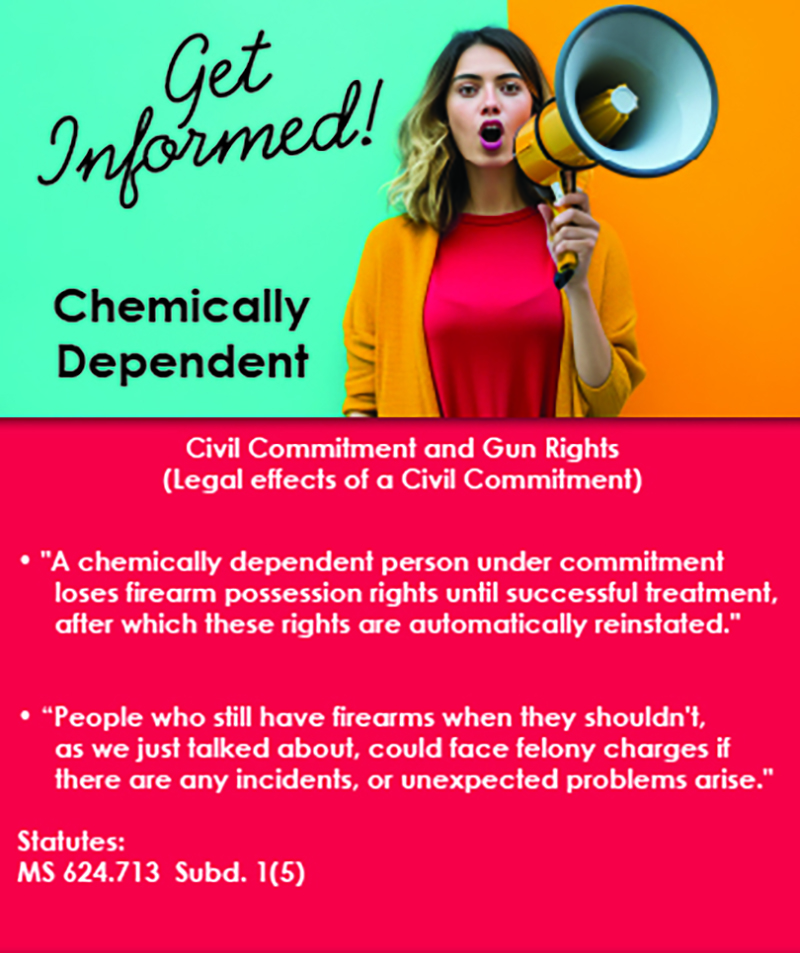
A chemically dependent person under commiment loses firearm possession rights until successful treatment, after which these rights are automatically reinstated.
People who still have firearms when they shouldn't, as we just talked about, could face felony charges if there are any incidents, or unexpected problems arise.
Statutes:
MS 624.713 Subd. 1(5)

A chemically dependent person under commiment loses firearm possession rights until successful treatment, after which these rights are automatically reinstated.
People who still have firearms when they shouldn't, as we just talked about, could face felony charges if there are any incidents, or unexpected problems arise.
Statutes:
MS 624.713 Subd. 1(5)
MS 624.713 Subd. 1(10)(iv)
MS 624.713 Subd 4

Process To Regain Gun Rights
To begin the process of having your rights to own or possess firearms or ammunition, or to inform someone else of the process of having them restored, use Minnesota Court Document FIR201 to petition the court in the county that held jurisdiction over the commitment. FIR201 can be found on www.mncourts.gov/GetForms and provides instructions and requirements to begin petitioning the court.
To petition the court in Itasca County, fill out form FIR201, and contact Itasca County Court Administration at 218-327-2870 to begin the process of bringing your motion before a judge. The court administrator will have additional paperwork to fill out and a filing fee may be required. A hearing will be scheduled following the processing of the application.
A person committed due to being at risk of harm (mental illness, developmental disability, or mentally ill and dangerous) loses firearm possession rights, which are not automatically restored after commitment.
If a person is committed due to being at risk of harm (mental illness, developmentally disability, or mentally ill and dangerous), their carry permit is automatically canceled.
Someone who has finished a civil commitment must request the court to restore their ability to own a gun. They need to provide evidence of mental health stability or three years of successful treatment for their condition
People who still have firearms when they shouldn't, as we just talked about, could face felony charges if there are any incidents.
Statutes:
MS 624.713 Subd. 1(5)


The Best Times to Use a Power of Attorney
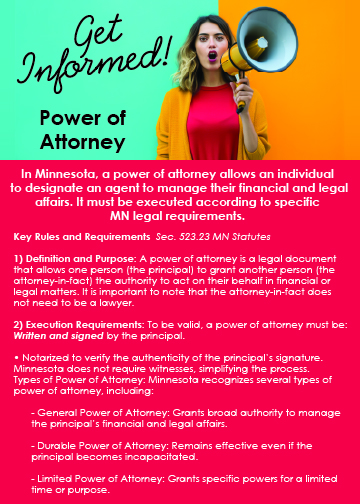
The best times to use a Power of Attorney are when you anticipate incapacitation or when you want to ensure that your affairs are managed according to your wishes. This may be upon being diagnosed with terminal illness, etc.
A “Power of Attorney” is a written document often used when someone wants another adult to handle their financial or property matters. A Power of Attorney is a legal form but is NOT a court form.
The “principal” is the person who creates a Power of Attorney document, and they give authority to another adult who is called an “attorney-in-fact.” The attorney-in-fact does NOT have to be a lawyer and CANNOT act as attorney for the principal.
Attorney-in-Fact Responsibilities: The agent must act responsibly as they would with their own affairs, put the principal’s interests first, and keep complete records of all transactions made on the principal’s behalf.
Statutory Forms: Minnesota provides a statutory short form for creating a power of attorney, which can be used to ensure compliance with state laws. This form includes important notices for both the principal and the attorney-in-fact.
For more detailed information, including specific statutes and sample forms, you can refer to the Minnesota Judicial Branch website and the Minnesota Statutes.
Forced Medical Treatment
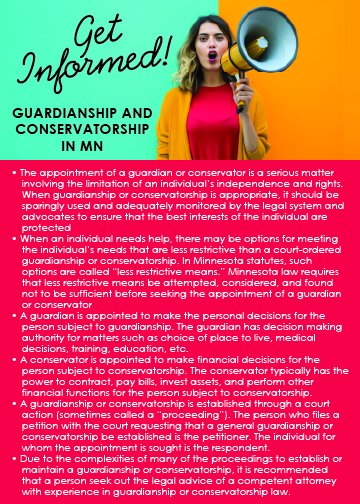
Myth: A guardian can force someone to take medication or participate in therapy.
Fact: A guardian cannot force someone to take medication against their will. Generally, only a specific court order (often called a Jaris Order) under civil commitment laws can mandate involuntary medication.
Restrictions on Beliefs
Myth: A guardian makes all medical choices based on their own judgment.
Fact: Even with medical power, a guardian cannot consent to care that violates the person's known moral, religious, or conscientious beliefs.
Controlling Social Circles
Myth: A guardian can block anyone they dislike from visiting or calling.
Fact: Under 2025 reforms to Stat. § 524.5-313, guardians cannot restrict communication or visitation unless they can prove a “substantial risk of significant harm”. If they do impose a restriction, they must notify the court and the individual within 48 hours.
Major Medical Procedures
Myth: A guardian can authorize any surgery or procedure.
Fact: Guardians are legally prohibited from consenting to sterilization, psychosurgery, electroshock treatment (ECT), or experimental treatments without a separate, specific court order.
Civil Rights
Myth: Guardianship removes the right to vote or get married.
Fact: A person subject to guardianship retains the right to vote unless a judge specifically removes it in a court order. They also retain all other civil rights not explicitly transferred to the guardian by the court.
• Information and forms can be found on the Minnesota Judicial Branch website:
• Guardianship (procourts.gov/Help-Topics/Guardianship); and
• Conservatorship (mncourts.gov/Help-Topics/Conservatorship).
• Guardianship and Conservatorship in MN Manual
(https://lf.mn.gov/docs/2025/other/251943.pdf)
Information Pending
Information Pending

How to Protect Yourself Against Fraud
● Do NOT BE AFRAID TO HANG UP THE PHONE!
● DO NOT open any links attached to emails or text messages - unless verified.
● Take the initiative, go to your bank IN PERSON, and follow up with your bank before making any decisions!
● Banks WIL NOT CALL YOU!
● Verify that the business or agency contacting you is legitimate
What to do if Your Information was Compromised
● Go to your bank and work with them to secure your accounts. You may need to open new accounts.
● Consider:
- Notifying the Social Security Office, this must be completed online.
- Contact TransUnion, Equifax, and Experian Credit Bureaus to either request credit alerts or freeze your credit, this can be done a year at a time.
PAD Stories
“My therapist suggested I make copies of my PAD, so I did that, and gave a copy to everyone I wanted to. There is a copy on file at the hospital, just in case, along with my general healthcare directive. I don’t want any mistakes made . . . Those are my wishes and that’s a legal document, and it must be followed.”
“I told my therapist that I had done a PAD and wanted to bring a copy to her to see what she thought — and she thought it was great. She thought it was wonderful that I had gotten very specific about my treatment preferences. I’ve also talked to my general physician about my PAD. My case worker and basically everybody has given me the thumbs up. They thought it was great for me to do this. That kind of made me feel better.”
“I had an Advance Directive in place at the onset of this setback when I started decompensating. I believe many years after this setback that I very possibly could have stabilized had I had an Advance Directive in place because choices of treatment would have been mine, choices I made when well, legally my wishes would have to be honored, and the person or persons I chose as my representatives would carry out my wishes or plan of treatment.”
